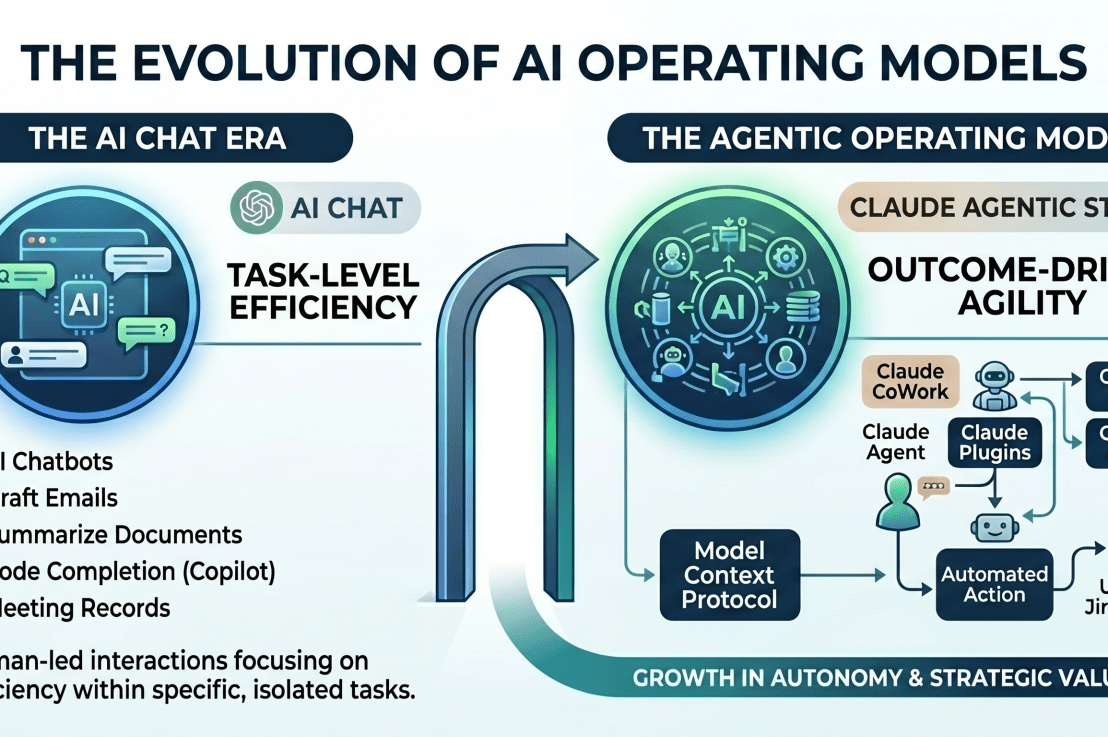
For the past two years, the conversation around AI has been dominated by the “Copilot” paradigm. We have focused on efficiency: developers typing faster, analysts summarizing emails, and engineers generating boilerplate code. While this has delivered incremental productivity gains, it has also trapped many organizations in a cycle of “task-level” automation.
As we move into the second half of 2026, the strategic imperative is shifting. We are moving from Copilots—which assist humans with tasks—to Agents, which drive outcomes.
The Limitation of the Copilot Era
The Copilot model was a transitionary phase. It relied on a “Human-in-the-Loop” for every action. If you wanted to deploy a service, you prompted the LLM, reviewed the code, executed the CI/CD pipeline, and monitored the metrics. You were still the architect, the operator, and the quality assurance layer.
This model excels at efficiency (doing things right), but it fails at agility (doing the right things at scale). It creates a “fragmented automation” debt where your technical team spends more time managing individual AI interactions than actually optimizing the business logic of the enterprise.
The Security “Scapegoat” and the Ferrari Paradox
Ironically, while the industry talks about AI-driven transformation, many leaders—particularly in public companies—are effectively “shooting themselves in the foot.”
I have witnessed CEOs and executives ban the use of AI for fundamental tasks like meeting recording and synthesis, citing security risks. They label it a “public company data risk,” effectively treating AI like a forbidden technology.
This is like driving a Ferrari like a bicycle.
By banning these tools, leaders stifle productivity and slash potential ROI. They use security as a scapegoat to avoid the friction of learning a new operating model. The reality is that the risk profile of an AI-powered meeting tool is fundamentally similar to the risks inherent in standard digital tools (email, cloud storage, collaboration platforms).
The irony is profound: the biggest security threat to your organization is rarely AI exfiltration; it is the stagnation of your workforce and the loss of institutional knowledge. Security should be managed through risk mitigation, governance, and compliance—not prohibition.
The Agentic Operating Model: A Strategic Pivot
The “Agentic Shift” is not about faster typing; it is about architectural autonomy. An Agentic Operating Model shifts the responsibility of execution from the individual engineer to an orchestrated, goal-driven agentic ecosystem.
In this model, you don’t ask an AI to “write this function.” You define the Outcome: “Our time-to-market for this module is 48 hours; ensure the deployment, security compliance, and testing pass the current production benchmarks.”
The agentic system then plans, executes, and iterates. It acts as an extension of the technical leadership’s intent, operating within the guardrails established by your governance and infrastructure.
How Public Companies Can Adopt AI Safely
Public companies do not need to ban AI; they need to operationalize it with rigor. Here is how leaders can mitigate risk while maintaining velocity:
- Shift from Prohibition to Governance: Treat AI like any other enterprise software. Implement policy-driven access controls, data classification, and logging. If your current security posture can handle corporate email, it can be adapted to handle AI-augmented workflows.
- Invest in “AI Literacy” Training: Just as you train staff on phishing, anti-bribery, and data privacy, you must train them on the responsible use of AI. Teach them what data can go into an LLM and what cannot.
- Deploy Private/Controlled Environments: Utilize enterprise-grade AI instances where data residency and confidentiality are contractually guaranteed. This eliminates the “leakage” fear while providing the utility of advanced models.
- Governance-as-Code: Use your existing infrastructure (like Kubernetes-based policy engines) to enforce guardrails on AI interaction, ensuring that agents only have the permissions they absolutely need.
Why this matters for the Head of Technology
For leaders overseeing cloud modernization and digital transformation, the implications are profound:
- From Managing People to Managing Intent: Your role shifts from managing daily developer cycles to defining the “intent-space” in which agents operate. Your expertise in Kubernetes, GitOps, and platform architecture becomes the foundational safety layer that allows agents to operate at speed without creating production incidents.
- Architectural Governance as a Moat: In an agentic world, bad infrastructure becomes a massive liability. The companies that win will be those with mature, observable, and immutable infrastructure. My experience in high-reliability systems (AKS, OIDC, Dynatrace) is exactly what’s needed to build the stable “control plane” that agentic teams require to scale.
- Outcome-Based Budgeting: We move away from measuring “lines of code” or “number of PRs” to measuring the successful completion of strategic business outcomes. This aligns technical throughput directly with board-level expectations.
The Path Forward
Transitioning to an agentic operating model is not a technical upgrade; it is an organizational one. It requires:
- A “Reliability-First” Culture: Treating agentic processes with the same rigor you apply to production deployments.
- API-First Thinking: Ensuring your entire tech stack is accessible and interpretable by machine agents.
- Strategic Sequencing: Prioritizing automation in the areas that directly impact your organization’s core value stream.
The future isn’t just about using AI. It is about building the systems that make AI a reliable, autonomous, and strategic engine for growth.
- Uncategorized

