For leaders and executives, the promise of Generative AI is immense, but the risk of unreliable output is often what stalls adoption. When deploying AI into production, a prompt that works in a chat window is not the same as a prompt that works at scale.
I’ve spent the last couple of weeks applying these concepts to build birdcall.co.za and an advanced surf-forecasting widget for oceaneye.co.za – my pet projects. By leveraging Claude, “Agentic” workflows, and strict evaluation pipelines, I’ve moved from “guessing” if a prompt works to having objective, measurable data that it actually performs.
Here is the S.D.O.L. breakdown of how to adopt AI in organizations while keeping risk front-of-center.
Situation
In serious applications—like managing a complex AWS infrastructure stack or generating precise wave decay algorithms for South African beaches—the “it works on my machine” approach is a liability. Users provide unexpected inputs that break standard prompts, leading to production incidents.
Decision
I decided to stop treating prompts as static text and started treating them as code. I moved from manual, subjective testing to a Prompt Evaluation Workflow. This shifts the development lifecycle from “write and pray” to “iterate based on metrics.”
Outcome
By implementing an automated evaluation pipeline, my first deployment of a complex AWS stack (CloudFront, S3, Lambda, DynamoDB, Cognito, Stripe) ran with zero issues on the first attempt. Similarly, at Oceaneye, we use a hybrid grading system—combining code-based validation for algorithms and human-feedback loops—to refine forecasts for specific GPS locations.
Lesson: The “Evaluation-First” Mindset
Most engineers fall into the trap of testing a prompt once and calling it “good.” In production, that prompt will break. To manage risk, you must adopt an evaluation-first approach.
The 5-Step Evaluation Pipeline
- Draft a Prompt: Start with a baseline instruction.
- Create an Eval Dataset: Use a diverse set of real-world inputs (or use Claude to generate them) to test your prompt’s boundaries.
- Feed Through Claude: Run your inputs against the prompt.
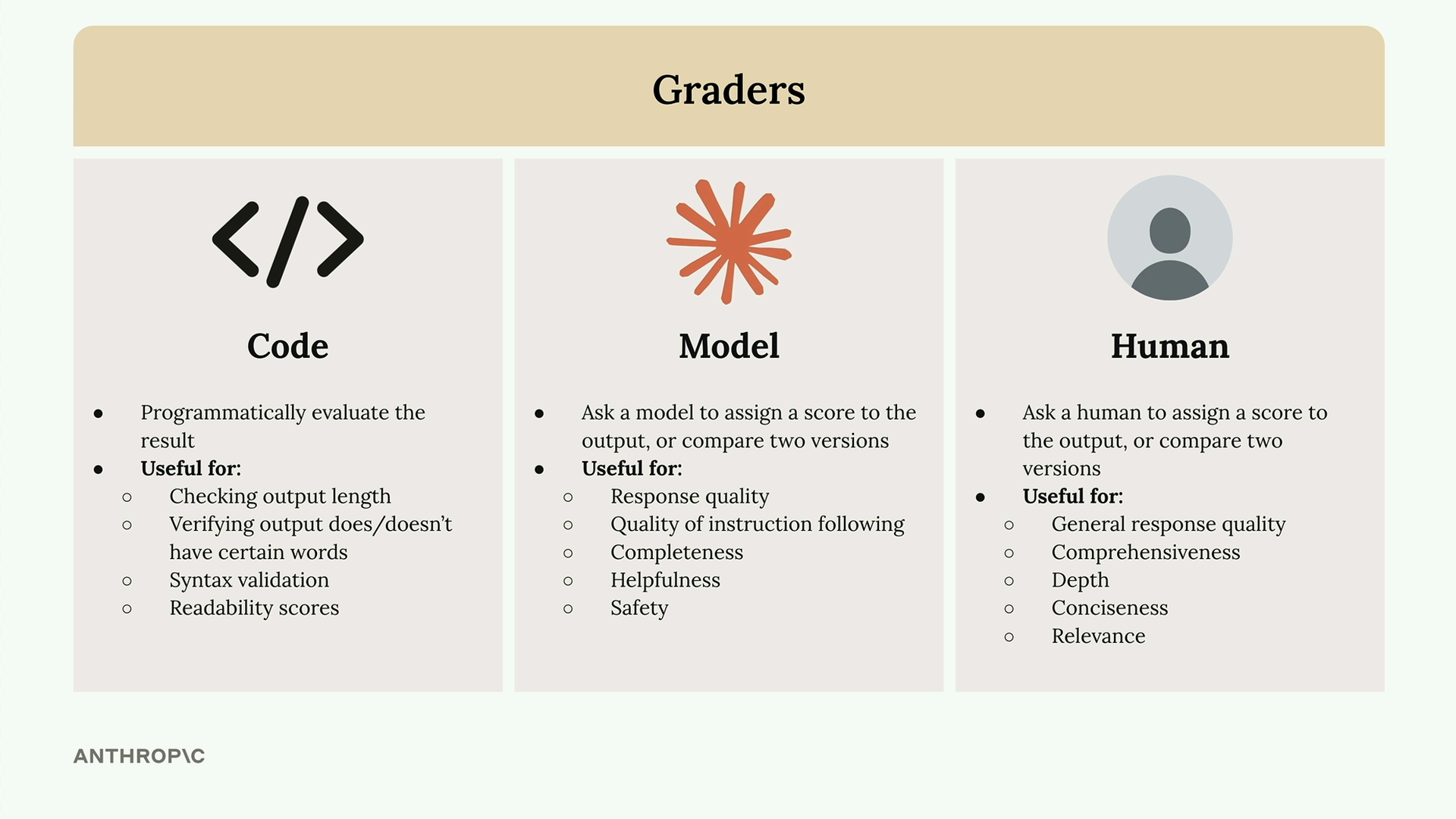
- Feed Through a Grader: This is the most critical step. Use Code Graders (to check syntax), Model Graders (to score quality), or Human Graders (for nuanced relevance).
- Change Prompt and Repeat: Iterate until your objective metrics reach your internal reliability threshold.
How to Start
Don’t wait for your team to build a massive infrastructure. Start by replacing the “I think this is good” mentality with a simple scoring system:
- For Code Generation: Use a Code Grader that attempts to parse the output. If the code doesn’t parse, the score is 0. This is an objective, binary gate.
- For Logic/Reasoning: Use a Model Grader. Ask a secondary instance of Claude to review the output against your requirements and assign a score (1-10) with reasoning.
- For Real-World Feedback: Use a Human Grader. For Oceaneye, when our forecasts don’t match the actual surf conditions, that feedback is ingested, and Claude then generates new test simulations to “patch” the underlying algorithm.
The Bottom Line
Reliability isn’t a feature; it’s a process. By building evaluation into your workflow, you don’t just “prompt”—you engineer. You transform your AI applications from experimental toys into stable, enterprise-grade tools that can handle the unpredictability of the real world.
How is your organization measuring the success of your prompts? Are you still relying on manual spot checks, or have you started automating your evaluation?
- Uncategorized

