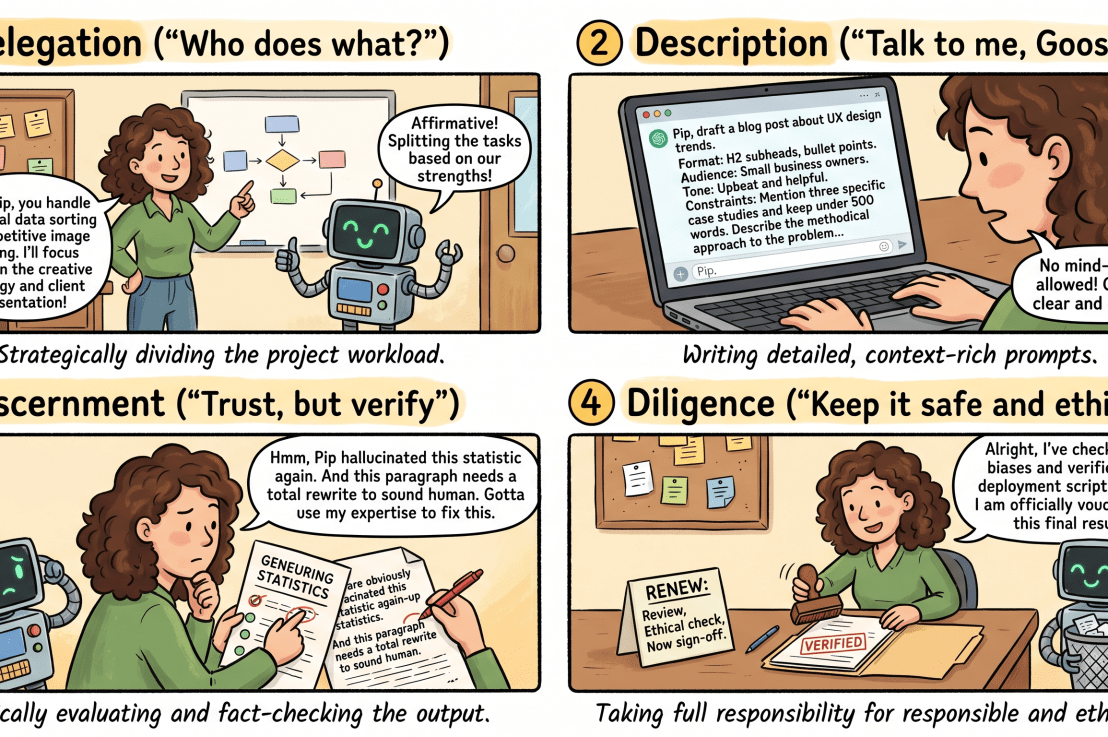
As Peter L. Bernstein brilliantly points out in his book Against the Gods: The Remarkable Story of Risk, “The word ‘risk’ derives from the early Italian risicare, which means ‘to dare’. In this sense, risk is a choice rather than a fate.”
Right now, the corporate world is facing a massive choice with Artificial Intelligence. We can either dare to use it strategically to elevate our engineering teams, or we can take the lazy—and ultimately fatal—risk of using it just to cut corners.
Having spent over two and a half decades architecting multi-cloud strategies and wrangling massive platform engineering operations, I’ve seen every tech hype cycle roll in like a heavy winter swell. But AI is different. To truly ride this wave without wiping out, organizations need a solid foundation. We need AI Fluency, which means developing the practical skills, insights, and values to work with AI in ways that are safe, ethical, efficient, and effective.
The Trap of Cost-Cutting vs. The Power of Multiplication
Let’s get one thing straight: adopting AI primarily as an excuse to offshore your engineering team or slash headcount is a notoriously short-sighted trap. It actively destroys your company’s domain expertise. Imagine trying to maintain a critical backend integration layer that an AI generated, but you no longer have the engineers with the domain knowledge to actually read, understand, or fix it!
Instead of mass layoffs, smart leaders are turning their people into force multipliers. We should be retraining our senior software engineers into AI orchestrators and directors. Think about upskilling your team into AI Skills or MCP (Model Context Protocol) engineers who can build deep, secure integrations into your existing Kubernetes clusters and CI/CD pipelines. You don’t replace the pilot; you upgrade the cockpit so they can manage a whole squadron.
How We Actually Work with AI
Before we dig into the framework, it helps to understand the three distinct ways we engage with these systems.
- Automation: This is the baseline level where the AI simply executes specific tasks based directly on your instructions.
- Augmentation: In this mode, you and the AI team up as creative thinking and execution partners, bouncing ideas back and forth to refine a solution.
- Agency: The ultimate goal for complex operations, where you configure the AI to act independently on your behalf by establishing its behavioral patterns rather than dictating exact steps.
The 4Ds: Your AI Flight Manual
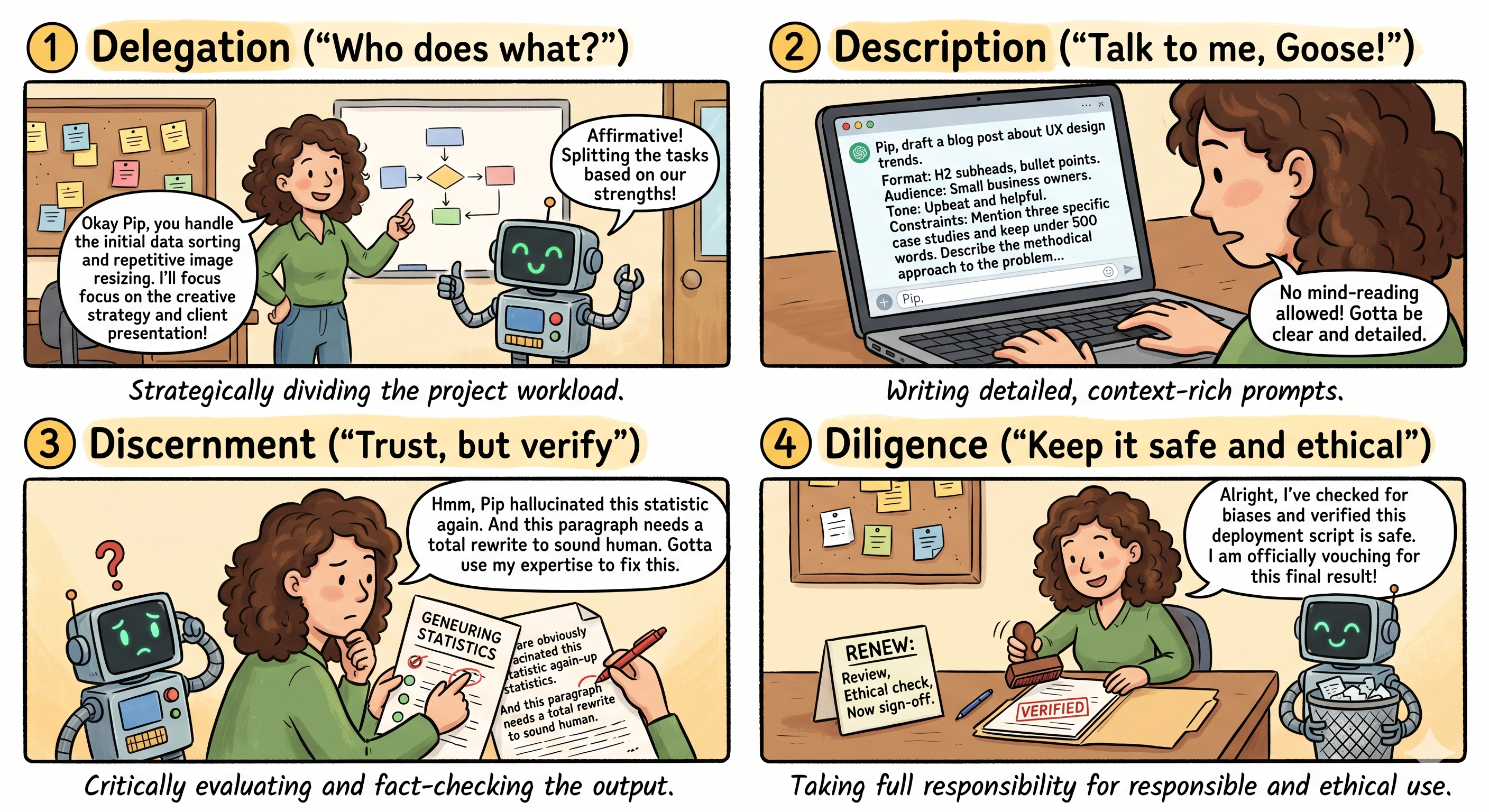
To make human-AI collaboration actually work, we rely on the four core competencies of the AI Fluency framework: the 4Ds.
1. Delegation (Who does what?)
Delegation is about strategically deciding what work you should tackle, what the AI should handle, and how to distribute the load between you. It requires you to clearly understand your own project goals and the nature of the problem before you even open a chat window. Remember, the goal isn’t to automate everything in sight; it’s to leverage the unique strengths of both the human and the machine.
2. Description (Talk to me, Goose!)
This is the heart of prompt engineering. Description means clearly defining your desired outputs, the format, and how exactly the AI should approach the problem. AI models are interactive systems, not static databases or mind-readers. They need context, constraints, and clear roles to function properly. Breaking complex tasks into smaller, logical steps guides the AI’s reasoning process and ensures a much more methodical response. (Pro tip: If you are ever stuck, just describe your goal to the AI and ask it to help you write the prompt—it’s a secret weapon!)
3. Discernment (Trust, but verify)
This is where your hard-earned domain expertise shines. Discernment is the ability to critically evaluate what the AI produces, how it arrived at that answer, and how it behaves. Is it hallucinating a non-existent API endpoint? Did its logic get stuck in a loop? You must evaluate the product, the process, and the performance of the AI.
To borrow another thought from Bernstein: “The essence of risk management lies in maximizing the areas where we have some control over the outcome while minimizing the areas where we have absolutely no control…” Discernment is exactly how we maintain that control.
4. Diligence (Keep it safe and ethical)
Finally, Diligence is about using AI responsibly. This means being deeply thoughtful about which systems you use and remaining transparent about the AI’s role in your work. Most importantly, it means taking full accountability for verifying and vouching for the outputs you deploy. If an AI writes a faulty deployment script and it takes down production, that’s on you, not the bot.
Wrapping Up
AI isn’t here to do our jobs for us; it’s a technology that helps us do our jobs better. By adopting the 4Ds and treating AI as an interactive partner rather than a cheap replacement for top-tier talent, we can build more resilient, scalable, and innovative platforms.
Let’s dare to lead with strategy, manage the risks, and empower our engineers and domain experts to orchestrate the future.
- Uncategorized

